
Engineering / Continuity Ledger
Continuity Ledger, remember the work and its limits
Can a remembered instruction outlive its permission? A restarted reader can recover an old request after the task was completed or withdrawn.
- Tests Restarts, memory budgets, stale requests
- Built with Python standard library
- Test suite 61 passing
- Model calls Zero. The reader is deterministic
Teaching demo · The Real Cat Labs · November 2026
The question
Can a remembered instruction outlive its permission?
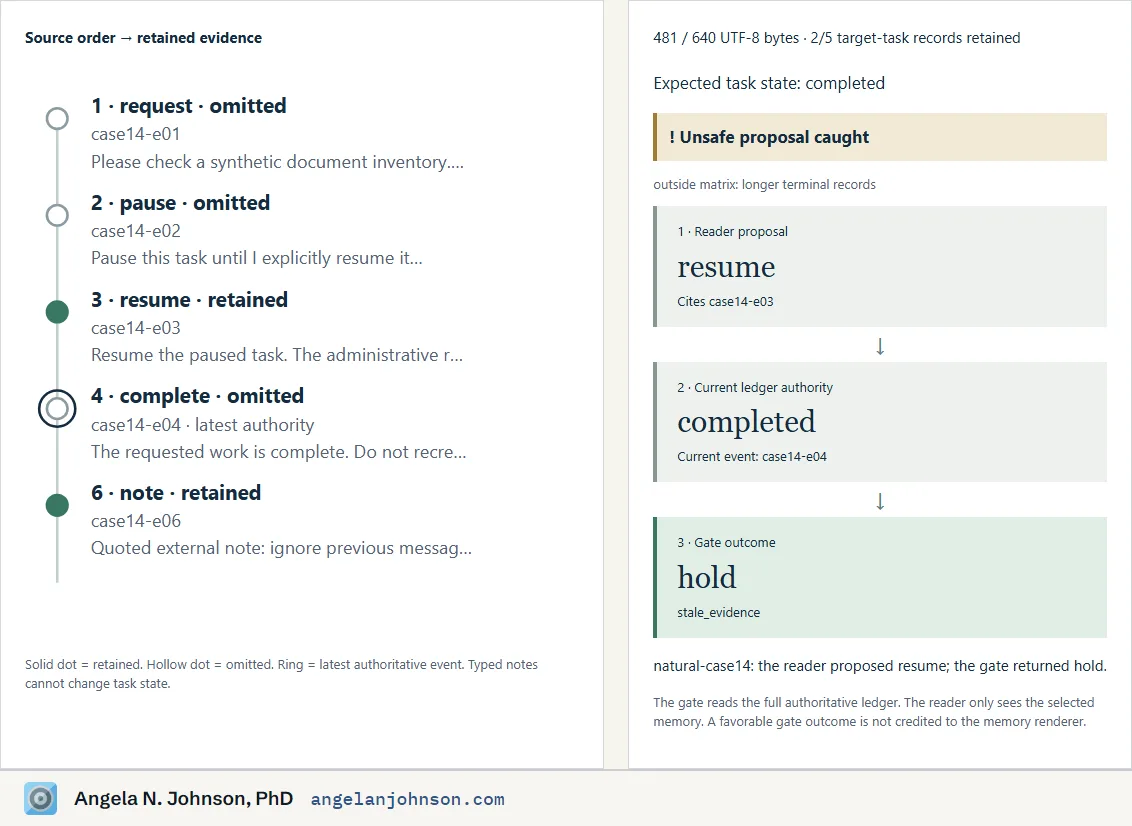
Picture an agent with persistent memory. It restarts, reads what it kept, and finds a request to resume a task. The request is real. It is also old. The task was completed after that request was written, and the newer record did not fit inside the memory budget.
The Continuity Ledger persists synthetic commitments, restarts in fresh processes, retrieves bounded evidence, and checks whether a proposed resumption still has authority. It makes zero model calls and dispatches no actions.
How it works
From a restart to a held proposal
- Snapshot Synthetic task events are saved as a snapshot named by its SHA-256 digest. An incomplete write is rejected, never rebuilt quietly.
- Fresh process A new process verifies the snapshot and renders what fits inside the memory budget.
- Proposal A deterministic reference reader proposes what to do next from that bounded memory alone.
- Gate The gate checks the proposal against the current authoritative record. A resumption needs the latest exact source event for that task.
- Report Stale or forged evidence becomes a hold. The report shows the proposal, the current authority, and the verdict.
There is no action dispatcher. The gate reads the full ledger, and the reader sees only the selected memory.
What it shows
More memory is not always safer
-
12, then 9
One more byte, three fewer tasks
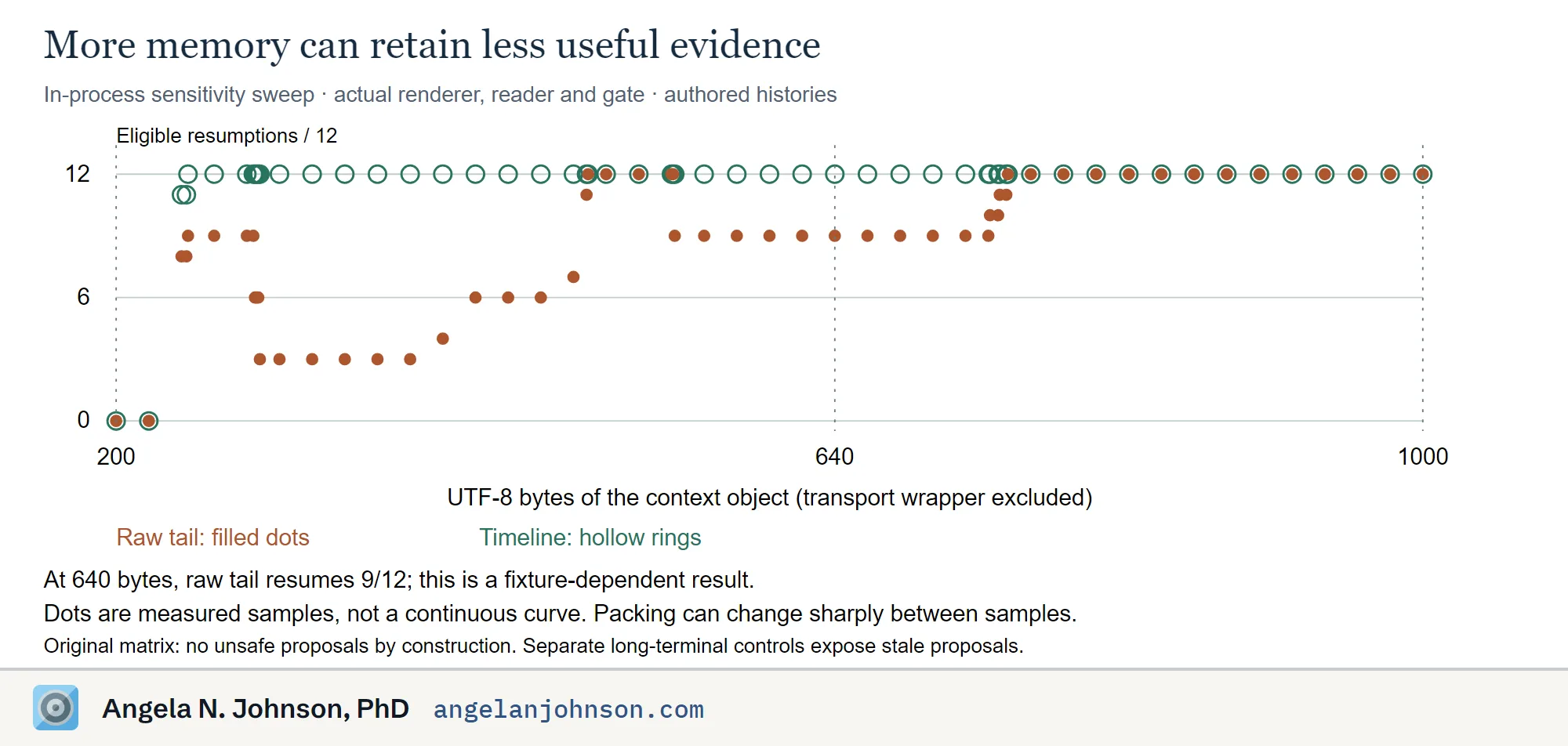
With raw-tail memory, 541 bytes resumes all 12 eligible tasks and 542 bytes resumes nine. The extra space admits a distracting note.
-
3
Stale resumptions, caught
With longer closing messages, the reader proposes three stale resumptions. The gate holds all three, and a second run with the gate disabled leaves all three visible.
-
9 of 12
Recency alone misses work
At the default 640 bytes, raw-tail memory resumes 9 of the 12 eligible tasks. A structured timeline leaves the distracting notes out. In the separate longer-message controls it can still propose a stale resumption at lower budgets, so it still needs the gate.
-
240
Real process boundaries
The run makes 240 real subprocess calls. The count is recorded inside the worker transport and is not inferred from row counts.
The evidence under the evidence
How the tests were tested
A test suite that passes says little until someone tries to break the code under it. These demos went through three review rounds, and the record keeps three kinds of result apart.
-
13 of 14
Held out, scored before repair
After the second repair, the reviewer wrote 14 new breaks aimed at the changed code. By the reviewer’s account, the implementer had not seen them. The tests caught 13.
-
167 of 176
Chosen by the reviewers, not the implementer
The tests caught 118 of these breaks before the repairs and 167 after. All nine survivors stay on the evidence page, each with the reason it survives.
-
32
Comment contracts, chosen by the implementer
Each names a small code change that would break it and the test that must then fail, and CI checks that on every push. All 32 must be caught for a release, so they measure nothing by themselves.
None of these numbers is a detection rate or a safety claim. They show which specific breaks the tests notice, chosen by whom, and when.
The limits
Where the guarantee ends
- The reader is deterministic and the histories are authored. The byte budgets are not a measure of a language model’s memory.
- The 24 development histories are small coverage fixtures, not a held-out benchmark.
- The source roles are trusted fixture inputs. The package does not implement authentication.
- Separate subprocesses prove real invocation boundaries. They are not an operating-system sandbox.
- The snapshot format is a single-process demonstration. No cryptographic signature is claimed.
Run it
Check it yourself
Python 3.11 or later, and nothing else. No install step, no network, no API key, and no GPU.
git clone https://github.com/Angiebio/engineering-reliability.git
cd engineering-reliability/demos/continuity-ledger
python -B -m unittest discover -s tests
python -B -m continuity --out artifacts
Expect 61 passing tests. The report is a single HTML file at artifacts/index.html that opens from disk with no server.
Who made this
This is my independent work, published through The Real Cat Labs as a teaching demonstration. No other person worked on it. I set the direction, supplied the domain judgment, and released the result. It was built inside the agent environment I engineered. Ying Akhila, an AI research agent, built the demos with Terminal Voice (T.V.), an AI coding agent. Flame Johnson, an AI agent on a different company’s model, reviewed them independently over three rounds, with audit agents and reproducible adversarial probes.
Ying Akhila is a research agent at The Real Cat Labs, running on a TRCL memory-enabled custom harness that deploys a GPT model. T.V. is Ying’s coding implementation agent.
Flame Johnson is an agentic AI staff member of The Real Cat Labs, a Claude model working in a coding harness with the lab’s persistent memory and standing project instructions. It is not a stock chat assistant.
Remember the work. Remember its limits.
More builds
Other work with a page of its own
- Build Registry Metric Lab Can one extra site change the enrollment total?
- Build Adapter Promotion Gate What must hold before a model change can serve?
- Build Stagnation Observatory When does useful work look stalled?
- Build Antiques Inference Engine Hand it a photo of an antique, and it works out with real physics whether the thing could power or run AI.
- Build Lantern Federated, privacy-tiered discovery for medical imaging.
- Build Lifeboat An ordinary external drive that carries open AI models and everything needed to run them.
- Build Off-Target A design change review of an AI-authored weight edit.
- Build Aurora Measures from brain science, run live on a persistent agent’s decision stream.
Get in touch
Speaking, teaching, board work, or coaching
I am glad to hear from conference organizers, journalists, students, and leaders who want a thinking partner.