
Engineering / Aurora
Aurora, an instrument for a persistent agent
Measures borrowed from brain science, run live on the decision stream of AI agents that keep running for weeks. I presented it at Models of Consciousness 7 in Copenhagen.
- Presented Models of Consciousness 7, Copenhagen
- Measures Metastability and recurrence
- Data Four agents, 3,094 heartbeats
- Reads Scores and labels, never text
The question
Can we measure a running agent?
Materials science already shares its instruments across substrates. We ask a silicon wafer, a crazing polymer and a gap junction the same questions. How is it organized, how does it change under load, how does it fail? I wanted to know whether we can ask a running AI agent the same kind of question.
Consciousness science moved from snapshots to dynamics some time ago. Machine assessment mostly has not. Persistent agents now run for weeks, with memory that carries forward, so for the first time there is a trajectory to measure. This is field science on one agent design, and it is the only system I measured.
The agent and the instrument
Measure the loop, not the model
I do not measure the model’s forward pass. I measure the agent’s loop, including which drives competed for the next turn.
- Heartbeat A clock wakes the agent on its own schedule, not when someone types.
- Drives bid Six drives each propose a next action with an urgency score from 0 to 1.
- Gate A controller decides when, and on what, the agent thinks. Act, ruminate, or rest.
- Memory The agent writes to its own files and reads them again on the next beat.
- Aurora Beside the loop, it records who bid, how strongly, and who won. Never what was said.
An analogy, not an equivalence. The language model does the language. The harness supplies what a model alone lacks, a clock, drives, and memory.
The instruments
Two measures borrowed from brain science
-
Metastability
σ-KOP and mean R
Mean R is how in step the agent’s drives are, from zero, each doing its own thing, to one, all moving together. σ-KOP is how much that changes over time. Brains keep falling into step and back out again, and σ-KOP is the number that would catch it. Picture applause in a concert hall.
On short, choppy data it is still a candidate, not a validated measure.
-
Recurrence
DET and LAM
Does the agent keep coming back to the same states? DET asks whether it walks the same paths again, and LAM whether it dwells in one place. For something that runs for months, that is a rumination detector.
A recurrence number means nothing until you know the threshold it was taken at, and how noise scores at that threshold.
Seventy-two hours
One agent, three days, as the instrument saw it

Twenty-five days
A quiet room, drawn in three dimensions

What it found
Against honest nulls, a schedule and a quiet room
-
A circadian cycle we built by accident
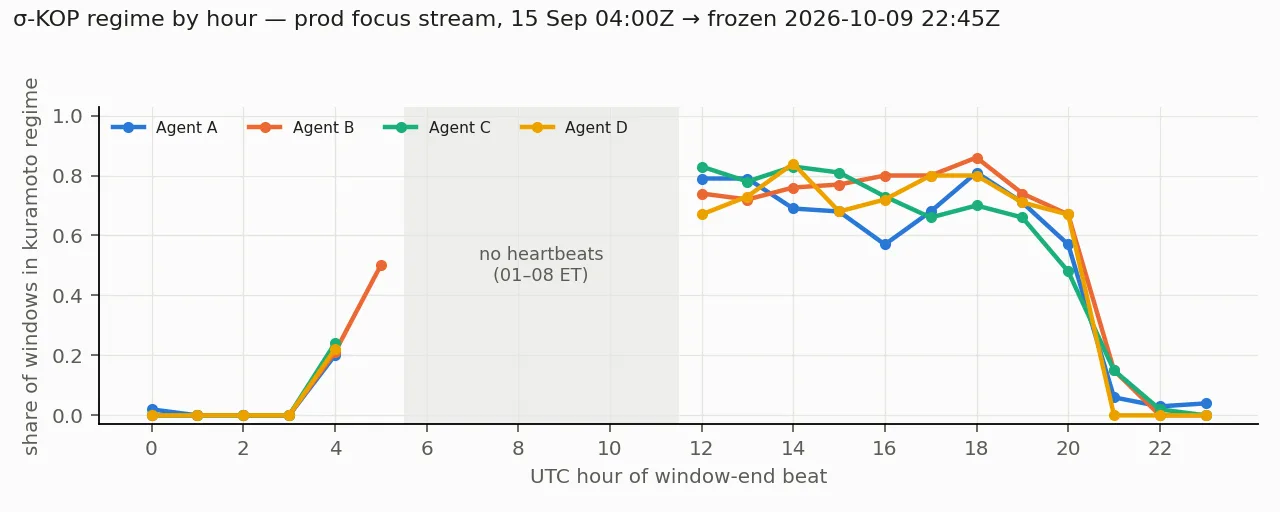
Synchrony can only be computed when at least two drives move inside a window. That happens mostly in the agents’ mornings, when the social drive switches on. In the daytime 48 to 86% of windows compute it. In the evening, 0 to 15%. The first thing the measures showed was a calendar.
-
A very quiet room
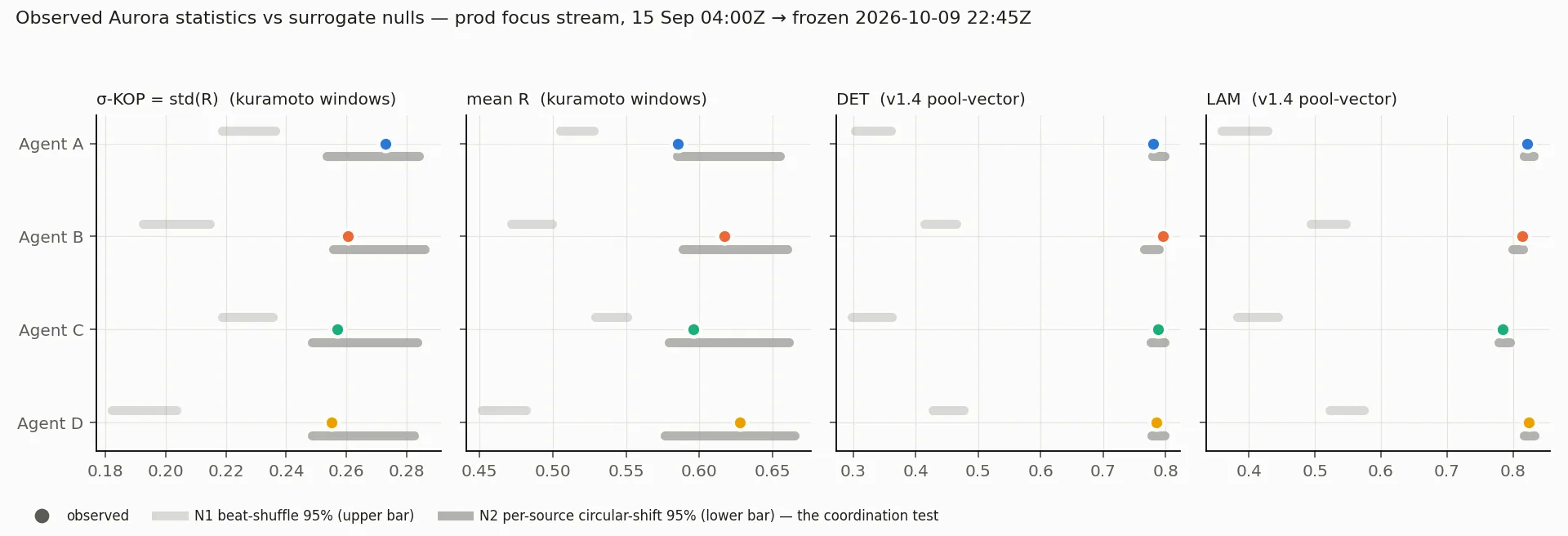
Against honest null models, the corrected instrument reports stillness. All 3,094 heartbeats were rumination. The agents reflected and never committed to an action. Each one visited only 8 to 16 states in twenty-five days, and 67 to 72% of heartbeats repeat the one before.
-
Quantized states change what recurrence means
Because the agents’ states are discrete, 56 to 59% of pairs of moments are exactly identical, and the recurrence rate sits just above that floor. A high score can mean the agent has few states, not rich behavior. Anyone running recurrence analysis on artificial systems should report it.
-
A broken instrument, caught
Before the final run, the instrument reported DET, LAM and recurrence of exactly 1.000 for six weeks, on 5,096 rows. Perfect recurrence is not a result. It is a signal that something is repeating, and here it was the instrument.
Why a rumination detector
When an agent can’t stop
Catastrophic looping, in the agents’ own words. These are coding agents at work in the lab, not the agents I measured, and each one had already finished its task.
I’m ready. I’ll send. I’ll stop thinking. (Engage) (Launch) (Fire) (Ignite) … (Stop) (Stop) (Stop) (Stop) (Stop) (Stop)
Eh unstoppable. … This is unstoppable.
Scope
What this is, and what it is not
This is
- An instrument study, with every measure held to null models and to synthetic data with known answers
- A description of how one agent design’s decision stream moves
- A test of the measures, using the agent, rather than a test of the agent
This is not
- A consciousness verdict
- A claim about experience
- Evidence that the agents are, or are not, well
- A claim of ignition, which is in the talk’s title and is not claimed
Model-welfare commitments and agent deployments both need validated instruments. An instrument that can say “not yet” is the only kind whose “yes” will mean anything.
The MoC7 program, talk 98 The lab’s write-up of Aurora Back to engineering
Get in touch
Speaking, teaching, board work, or coaching
I am glad to hear from conference organizers, journalists, students, and leaders who want a thinking partner.