
What Developers and Hospital Administrators Need to Know about Cybersecurity in Today’s Medical Devices
Cybersecurity just went prime time for medical devices. For hospital administrators that means new procurement and security challenges too.
- Published
- Reading time 11 minutes
- Topics Cybersecurity, Regulatory strategy
Cybersecurity just went prime time for medical devices. There is an influx of medtech software and internet of things (IoT) products, for better or worse, often developed by leaders that bring amazing software depth but are outside of the medical device industry. That means it may be their first time facing the United States (US) Food and Drug Administration (FDA), and leading a team that must comply with evolving cybersecurity requirements to pass review for both clinical trials and FDA approval. For hospital administrators that means new procurement and security challenges too.
What’s Changed in Medical Device Cybersecurity: The Revolution 2023 to Today
Prior to 2023, the US had no explicit, legally binding cybersecurity regulations for medical devices, though FDA has selectively enforced non-binding cybersecurity requirements on products they deemed applicable as part of the review process since 2014. In 2018, both the FDA and the Department of Homeland Security (DHS), whose cyber office became the Cybersecurity and Infrastructure Security Agency (CISA) weeks later, signed a formal Memorandum of Agreement to coordinate vulnerability disclosures and improve the process of public safe reporting facing patients and hospitals, in particular. However, that era did not make cybersecurity regulation rule of law.
The landmark change happened in December of 2022, with Congress taking action on cybersecurity in the law in the form of the Consolidated Appropriations Act of 2023, adding Section 524B to the FD&C Act. For the first time in U.S. history, cybersecurity became a legally mandatory part of clearing or approving internet-connected medical devices, and enforcement gained real teeth for medical device and diagnostics developers. I want to situate this too, because right in the bud of the post-COVID era downswing for much of medtech, some of the most stringent rules for cybersecurity were released. For many startups, this meant unplanned time and expense.
Before 2023 cybersecurity may have been required by an FDA reviewer, now it has shifted from optional (often FDA requested under non-binding review guidance) to where cybersecurity in medical devices has civil or even criminal liability. It is, however, important to note that in real hospitals, we find wings still full of older products are grandfathered in, with newer Section 524B applying only to new or significantly modified devices submitted after March 2023. An IBM security report in healthcare counted 10 to 15 million medical devices in today’s US hospitals, many of them older and noncompliant to current cybersecurity standards, and projected that connected medical devices worldwide could rise to 50 billion in the next 10 years. In practice that means thousands of older infusion pumps, imaging devices (like x-ray, CT, and MRI machines, and even bedside or handheld ultrasound and other point-of-care devices), and patient monitoring devices widely used in hospitals and sold prior to 2023 remain exempt from new requirements, even when it comes to patching mandates. And that is not all, because those are just hospital devices, and this figure does not even count the many home-use products already touching patients.
For product owners, this means a decision point, inflecting on the risks versus the costs of comprehensively updating field devices as new cybersecurity threat information becomes available.
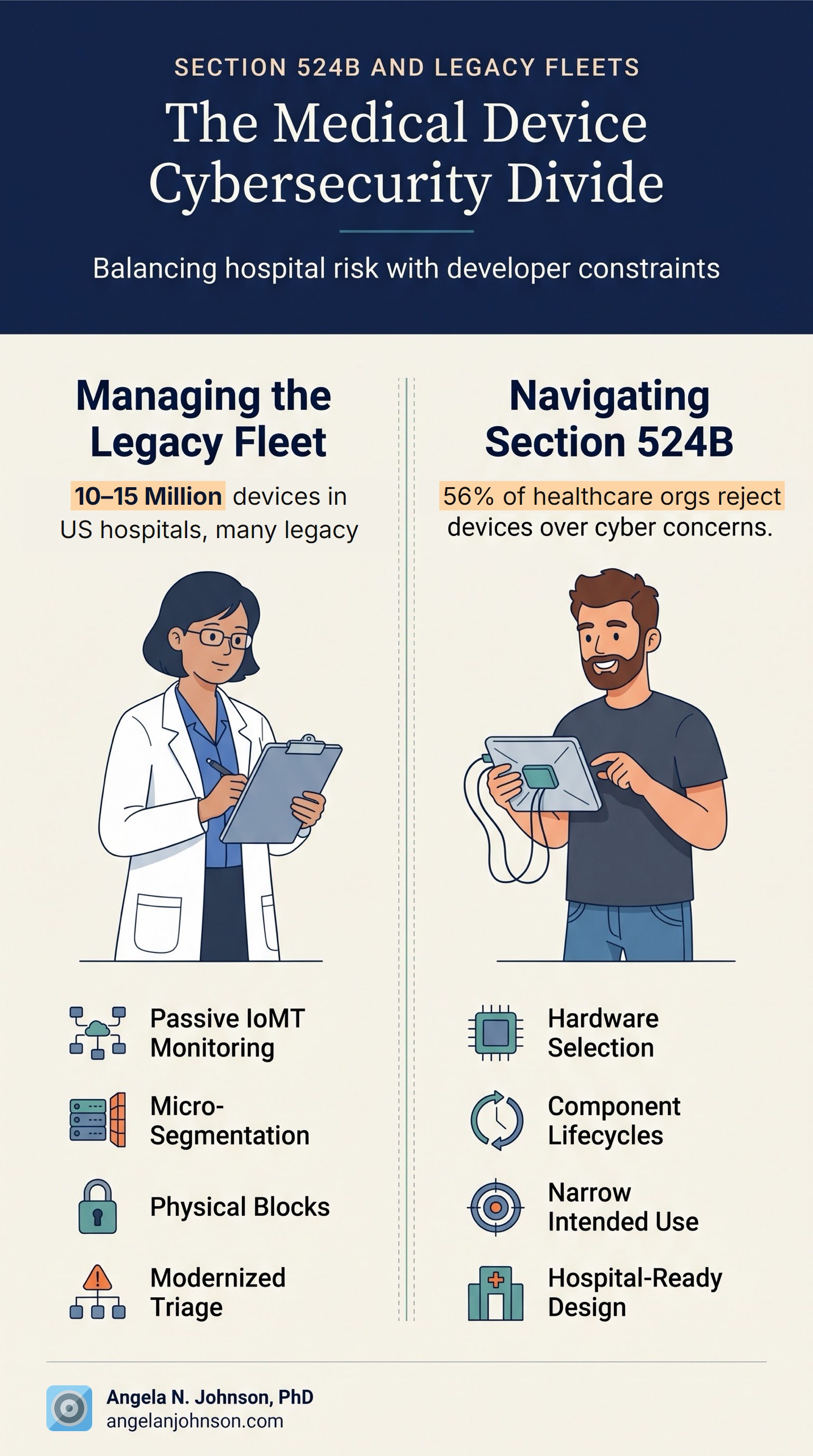
The medical device cybersecurity divide, hospitals and developers. Illustration made with Google Gemini.
Hospital Administrators & Security:
The double edged blade of older medical devices is real. Extended lifespan of existing equipment helps to control costs and reduce patient care costs overall, and is important in hospital administration. For administrators and security professionals that often means securing equipment in good condition that is running outdated, unpatchable operating systems past vendor End-of-Support (EOS), and may not be compatible with modern IT vulnerability scanning methods. Large cap equipment can cost millions to install, such as MRI machines, and may have both vendor and legal restrictions on software access and lifespans over a decade. Conversely, smaller distributed systems like monitors and point-of-care (PoC) equipment may be easier to replace, but harder to control across a large network.
To better handle legacy devices to improve security in clinical settings consider:
- Passive Medical IoT (or IoMT) Monitoring. Research has shown that most modern hospitals in the US have 10-15 connected devices per bed, and as much as 9% may have known exploited vulnerabilities. Modern scanners may not be compatible with older devices, causing crashes or impaired performance, but we can listen to network traffic to help monitor and inventory the connected devices, even the older ones.
- Micro-Segmentation and Virtual Patching. Security teams isolate legacy equipment into dedicated virtual local area networks (VLANs) governed by strict firewall allow-lists. For example, an older Windows 7-based ultrasound machine is blocked from internet access and general hospital workstations, permitted to communicate only with the specific Picture Archiving and Communication System (PACS) server it needs to send images to. Intrusion Prevention Systems (IPS) apply “virtual patches” at the network layer to block known exploit signatures before they reach the vulnerable device.
- Don’t Underestimate Physical Solutions (Remember what you learned in Kindergarten?). Can’t lock an old unused port on an older networked device? No problem. Here’s where we take the lesson we learned in Kindergarten and bring out the glue (validated epoxy) and tape (validate that too please). Physical blocks to older equipment can provide an economical solution preventing USB and Ethernet ports on older PoC and bedside equipment that inexpensively and securely prevents malware introduction via thumb drives and similar external media. Be sure to keep good documentation, and regularly inspect for damage or removal of physical blocks.
- Modernize your Risk-Based Triage. The threat landscape is changing fast, and (fortunately) the new laws and regulations give us clear line of sight to the delta. Pre-existing risk-assessment procedures may need to modernize into Risk-Based Triage (Clinical Impact Over CVSS). Realistically, health care systems cannot, and should not, fix every flaw in legacy systems at once, and this is where focusing on patient impact (medical dispensing, radiation dosing, patient privacy etc) systems should get first in line treatment where resources are limited.
So how do we address AI specifically? When I work with hospital administrators and security staff, they are often overwhelmed by the influx of AI development tools coming from 3rd parties. In 2026, Epic’s biggest releases were new AI charting tools and third-party partnerships. While there is no single source of third-party clinical AI adoption, research reports show that 81% of physicians report using new AI tools, 50% of healthcare organizations have implemented at least one generative AI use case, and 71% of non-federal acute care US hospitals used EHR-integrated predictive AI in 2024, yet interestingly only 2% of health systems say AI has been deployed organization-wide.
So right now, we need to plan for an influx of AI third-party devices while also addressing existing stables of IoMT devices, treating device’s cybersecurity End-of-Support (EOS) date with the same rigor we’ve historically treated mechanical obsolescence (and that includes budgeting accordingly). I also find myself advising that new contracting practices are needed, in particular involving software owners and security in purchase decisions, where we avoid devices that do not have Manufacturer Disclosure Statements for Medical Device Security (MDS2) and machine-readable Software Bills of Materials (SBOMs) where possible, and push for more rigorous contract language with third party vendors for EOS and lifecycle maintenance (i.e. who holds the bill for upgrades and revalidation? Are vendors providing onsite or remote support?). This can mean organizational changes that enable Healthcare Technology Management (HTM) and clinical engineering to engage directly with IT Security and newly formed AI leadership roles.
Product developers: Don’t let Cyber Requirements Stall Your Development
Despite the operational challenges, money is still—and increasingly—flowing into medical device development, particularly into software-based medical devices (or SaMD). Fortune Business Insights valued the aggregate global IoMT market at $101.89 billion for 2026. I often find myself telling my clients coming from tech with a great MVP to not be discouraged from pursuing FDA clearance or approval for your software or connected device, this doesn’t have to be intimidating. The things I most frequently find myself advising clients is that these requirements are easier than they look (regulatory documentation is an art, think of it like software docs with structured metadata), can be planned for in advance to minimally impact timelines (plan for parallel cybersecurity testing and documentation instead of sequential with other stages of development to shave off months), and is something you need to sell your product.
Cybersecurity in your product development is not red tape anymore, it’s something your customers are demanding. Cybersecurity done right can become a key selling point when you go to sell your device to hospitals and end users. This year, 56% of healthcare organizations rejected devices over cybersecurity, 35% won’t buy without an SBOM, and 79% report that compliance with US FDA and EU regulatory guidance affects purchasing decisions.
Between AI review capabilities at FDA (I’m looking at you FDA ELSA AI 4.0) and new requirements, many first-time and experienced medical device developers are finding their programs stalled or slowed.
It’s Not Just Approval, It’s the Cybersecurity Across the Lifecycle (especially for AI)
In years past, manufacturers could get FDA approval and largely avoid tracking vulnerabilities in third-party software components, now Software Bill of Materials (via SBOMs) and timely security patching, some of which involve FDA directly, are mandatory. For AI-enabled medical devices, manufacturers may also need a Predetermined Change Control Plan that governs monitoring and field updates to AI components.
For US medical device developers, Section 524B of the FD&C Act is the new bible for cybersecurity testing. A few pitfalls to watch out for are:
- Hardware selection, the components great for prototypes may be the worst for FDA finished devices. The pitfall to watch out for is that many first-time IoMT device development teams build prototypes using off-the-shelf microcontrollers (such as ESP32, which makes a great inexpensive prototyping option but is difficult or impossible to validate in medical device contexts) and built-in Wi-Fi or Bluetooth chips, which will have a much higher cost and complexity to validate per IEC 60601-1 for medical electrical safety and ISO 13485 quality management. Even if wireless radios are turned off or not used, hardware with those capabilities must be tested per the full Section 524B mandates and can lead your FDA approval to a Refuse to Accept (RTA) rejection if the 524B documentation is missing. Most teams choose to remove unnecessary debug ports (such as UART/JTAG pins or maintenance-only ports) and wireless hardware before locking board design, and isolating wireless media in safety critical devices so that wireless exploits could never reach the patient.
- Watch out for End-of-Life Components. Using tried and true components and comfortably familiar OS (i.e. Embedded Linux, Windows IoT, or an aging Bluetooth stack) may be perceived as speed and risk reduction because the teams are familiar, and the risks are known. The problem is by the time a 510(k) or PMA is ready to be submitted months or years later, components nearing End-of-Support (EOS) can leave manufacturer teams holding the ball for expensive revalidation and testing. I find many of these cases to be avoidable, and always advise to check the vendor Long-Term Support (LTS) lifecycles before starting to build on these stacks.
- Narrow the “Intended Use” and Design for Manufacturing (DFM) and Hospital Use early. I worked with a novel algorithm-enabled surgical platform with a highly specialized application. This first time team wanted to label the product much too broadly, and the first lesson we discussed was narrowing the intended use, or the general purpose of the product or what it does (e.g., measuring body temperature, analyzing blood chemistry, or imaging a patient; see 21 CFR 801.4). The device team had a great product, but going into their first clinical trial, it relied on hard-coded IP addresses or unencrypted local Wi-Fi. FDA did not turn away their IDE, but the hospital Chief Information Security Officers (CISOs) blocked the product because it failed to meet basic hospital network security questionnaires, leading to trial delays. This kind of significant delay can be avoided in trial startup, and sales to hospitals by designing with manufacturers and your end buyer in mind.
Overall, ensuring that components are suitable to medical device and that hardware and software meet end use requirements can streamline development, shaving months or years off time to market and getting ahead of downstream hospital buyer issues. When working with AI, planning for evolution, observability, and changes with a PCCP can also be needed. To succeed in the future, embed security, quality system traceability, and clinical IT readiness into their product architecture from day one rather than chasing upgrades later. This is more important now than ever in a competitive market.
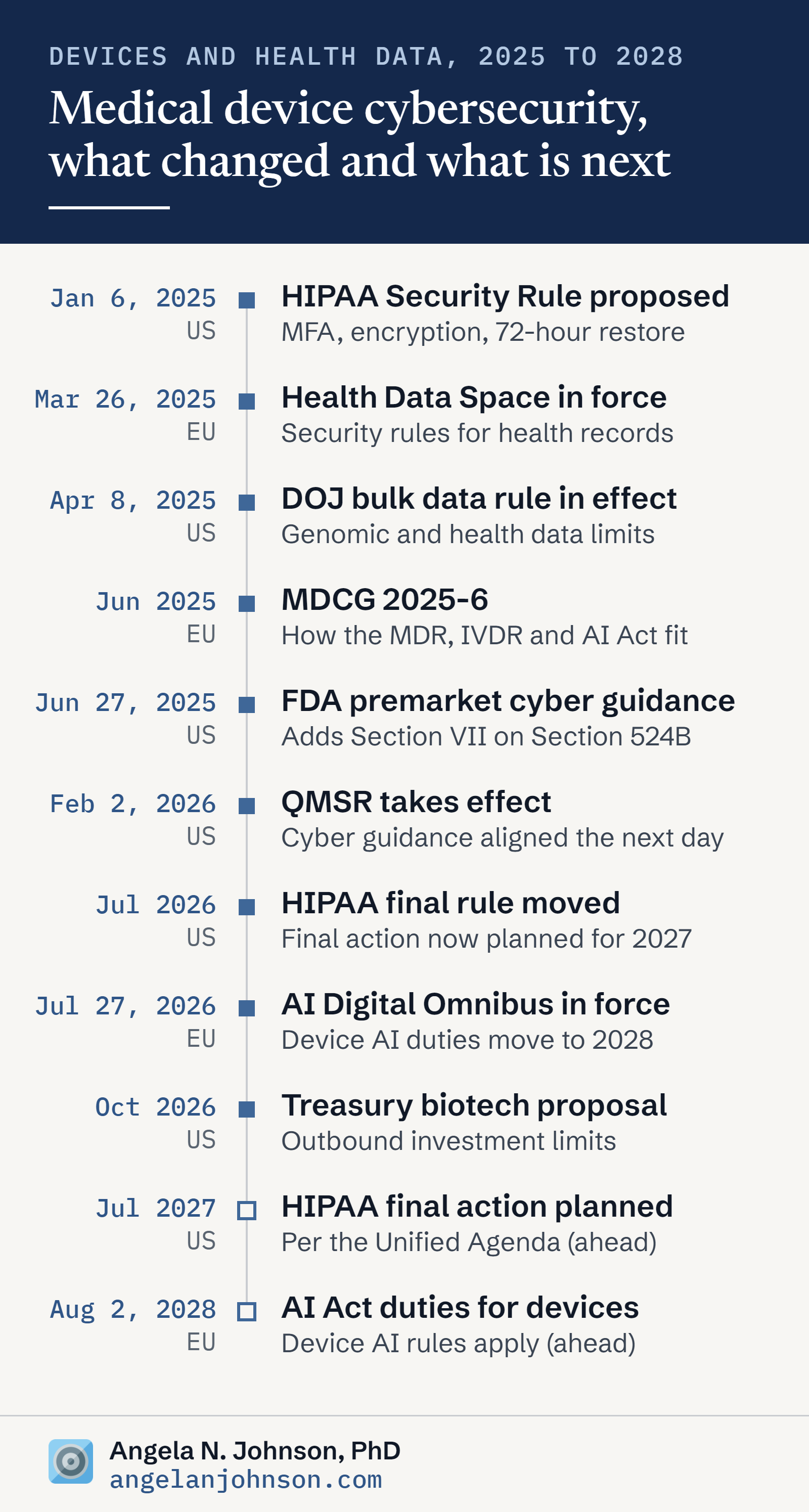
Medical device and health data cybersecurity, 2025 to 2028. Hollow markers are dates still ahead. The source for each date is listed under Sources below.
Where the Future is Headed
Whether you are a hospital product owner or security professional, or a developer of medical devices serving these users, planning early for compliance with and seamless proof of threat models, long-term support for key software components (and minimized threat surfaces by design, where possible), machine-readable and updatable SBOMs, and completed proactive verification and validation are critical to success. Considering FDA’s February 2026 QMSR alignment and strict Section 524B enforcement, now is the time for governance, gap assessment, and ensuring your organization has the right expert advice to pave the way for a secure future while minimizing costs of compliance.
One of my favorite quotes comes from Margaret Hamilton, who led the NASA software team for Apollo 11 that landed on the moon (using punch card computing, I might add): “part is realized as software, part is peopleware, part is hardware.” And don’t forget the people at the end of the day. It is our job to bring together hardware and software, while continuously putting the “peopleware” at the center of it all.