
Insights / Regulatory strategy
Making Investment Decisions in China, EU and the United States as Drug Development Regulations Evolve: Technology isn’t just for Medtech, it’s about to Reshape Biotech as We Know it
China has emerged as a strategic market, and a leader in some areas of biotech and medtech development, fundamentally altering development and investment landscapes.
- Published
- Reading time 10 minutes
- Topics Regulatory strategy, Life sciences strategy, AI leadership
Biotech as we know it is changing. In just a little more than a decade we’ve moved from early-stage cell and gene therapies (CGT) to complex regenerative medicines. I could tell you war stories about triple combo products, where device materials testing, chemistry for small molecules, and human cell and gene products intersected firsthand, as one of the pioneers in Flagship Ventures’ Sigilon Therapeutics (2023 Lilly acquisition, up to $310M) and many other advisory leadership roles in regenerative medicine and devices. Now we are also seeing prime-time come for computational and AI-driven discovery programs, real-time data enablement for clinical trials, and a complex shift in the global landscape with China emerging as a leading biotech innovation powerhouse alongside the US and EU.
China has emerged as a strategic market, and a leader in some areas of biotech and medtech development, fundamentally altering development and investment landscapes. This article provides both history and what you need to know to make your strategy work. What you should be thinking about now:
- AI Impact on Manufacturing, Development and Scale: Both biotech and medtech are moving to AI-driven GxP operations, from R&D to manufacturing lines and even into the clinical trial space, with prominent companies like Veeva announcing new AI agent technologies to support clinical trials. From improving quality, detecting supply chain constraints, and even recruiting patients AI will play a role moving forward, with the AI-in-biotech market estimated to exceed $25 billion by the mid-2030s.
- Discovery Accelerated by Generative Chemistry, Biologics & Autonomous Labs: Some of us may remember the gold rush of natural products chemistry, the early days of computational modeling, and now we watch it go mainstream with commercial and start-up biopharma organizations using AI-driven proteomics and drug discovery. Frontier companies like Anthropic have programs that now support protein design.
- Clinical Development and Contract Research at Start-ups: AI can dramatically accelerate small teams. OpenAI for Healthcare’s early 2026 launch has expanded its healthcare partnerships and offerings. In 2026, AI frontier giant Anthropic purchased Mithril Medicine, a “one-person” AI powered biotech, a bet in a new trend of minimalist biotech companies that could accelerate early development at a fraction of the cost of traditional development. This changes the landscape not just for start-ups and investors, but also for the contract research organizations, or CROs, supporting new minimalist product teams, requiring us to rethink traditional data platforms, strategy, and efficiency.
Global Evolution in a Decade, and Why It Matters for Development Strategy
In 2020, the US held the lion’s share of new biotech patents in the world (about 39%), but China has rapidly gained on the US in raw biotech patent filing volume in recent years (though question on quality of patents and international patent process is not apples to apples). Yet US remains the global leader in high-value international IP, foundational biomedical funding (anchored by a $48.9B FY2026 NIH and ARPA-H budget) and deep venture capital markets. Since 2025, U.S. biotechs have raised $37.2 billion, that’s about 68% of total worldwide venture capital funding, centralized heavily around San Francisco Bay Area and Boston. It is important to note the shift in the regenerative medicine boom of the mid 2010s, into the COVID era (we’ve all heard of Moderna, certainly those of us working with Flagship companies) vaccines and an array of supporting device and bioprocessing products, and now into a challenging funding environment that focuses more heavily on mature bets and computationally enabled discovery.
Making smart bets now and in coming years will mean breaking down medtech vs biotech silos, to make way for computational technologies and advanced materials. This requires a fundamentally different approach to diligence and to development strategy that crosses the medtech vs biotech swimlanes, and often also the intersection with technology, AI, and data providers.
These changes mean we must assess and develop strategy in new, smarter, and cross-functional ways, which means new skillset for leaders.
Europe’s Renewed Focus on Compliance and Supply Chain
In recent years, the European Union has focused on the compliance and supply chain environment. Many manufacturing man hours have been spent navigating, for example, new materials, extractables and leachables (E&L), and PFAS compliance in EU. Regulatory overhaul in Europe has ushered in CTR, MDR, and a new Quality Innovation Group, among others, as well as the EU AI Act’s new framework. While the EU maintains a diverse and stable patent footprint (largely stable across the prior decade and presently at approximately 18% globally), it faces heightened competition in clinical trial volume and new drug approvals from both the US and China, as well as new challenges in working in the post-Brexit MHRA environment evolving in the UK.
China Biotech Regulation Then and Now
In the late 1990s, China’s medicinal product regulation was going through major reform in how drug and device oversight was regulated, moving from fragmented provincial standards to a central, modernized national framework launched in 1998 creation as the State Drug Administration (SDA) which triggered broad international attention and collaboration, in particular in anticancer drugs. Tension between Ministry of Health’s Drug Administration Bureau and State Pharmaceutical Administration of China (SPAC), as well as innumerable regional Traditional Chinese Medicine authorities and associations. SPAC’s primary mission was to promote the economic growth of state-owned pharmaceutical enterprises, creating a direct conflict of interest when it also oversaw manufacturing and device standards. Enter many international scientists, including myself. I first supported a Chinese clinical trial and clinical IT projects in the early 2000s, and by 2013 I was leading Fortune 500 projects and teams with both US, EU, and Chinese clinical trial and regulatory staff. I sometimes laugh that I’m old enough to slip and say “SFDA” every once in a while.
Established in 1998 as the SDA, the China SFDA soon became the China Food and Drug Administration (CFDA) in March of 2013, and in 2018 it further evolved into the modern China National Medical Products Administration (NMPA) (English link to agency overview, see primary Chinese sources without official English translations in [2-6]; Li et al. provides a helpful history of China’s medicinal product regulatory evolution in English publicly available [7]).
China’s medical product regulator transitioned from the State Food and Drug Administration (SFDA) to the China Food and Drug Administration (CFDA) in March 2013, and then to the National Medical Products Administration (NMPA) in 2018 (approved March 17, 2018, and unveiled April 10, 2018) under the State Administration for Market Regulation (SAMR).
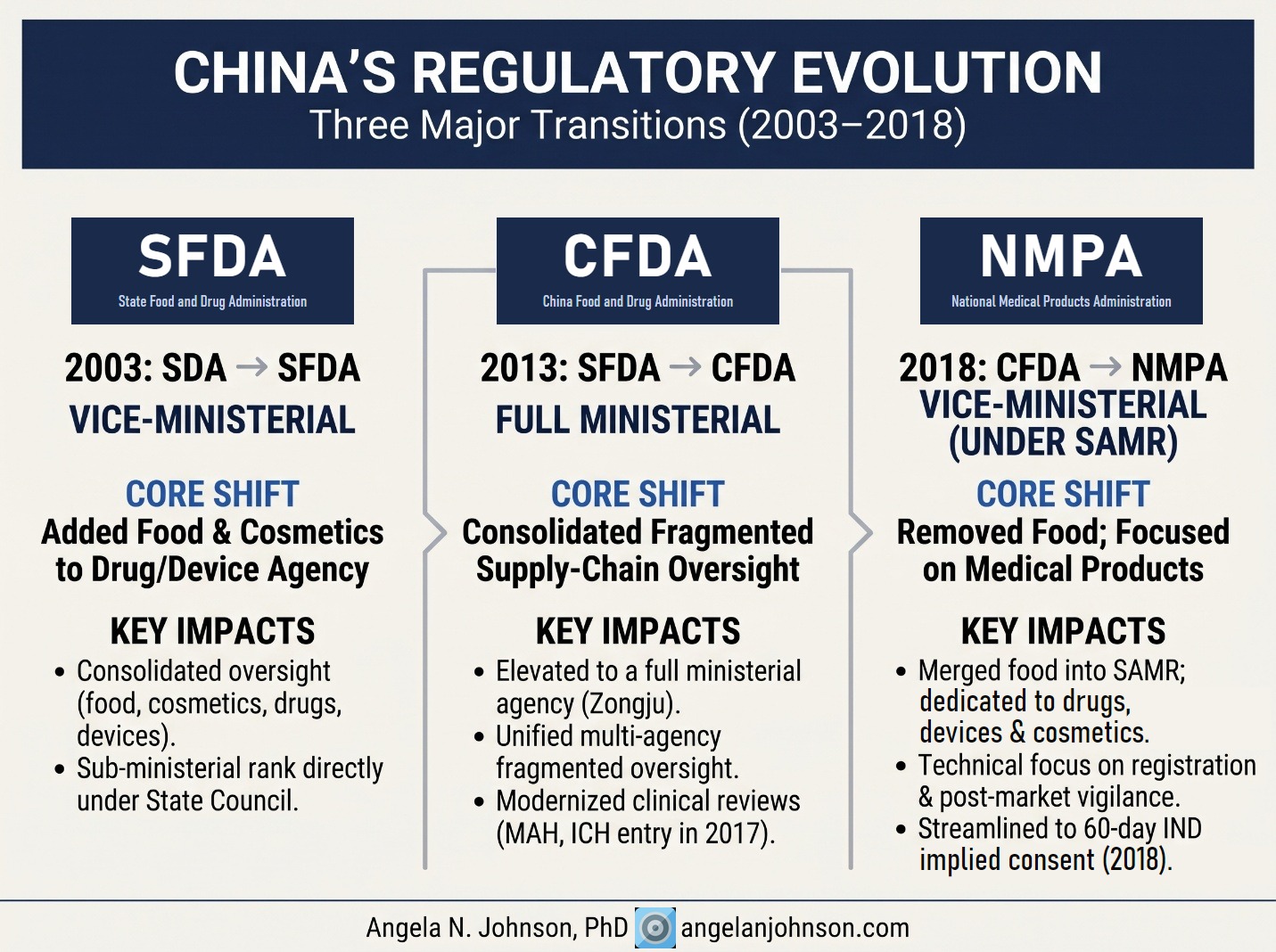
China’s regulatory evolution, 2003 to 2018. Illustration made with Google Gemini.
The formation of the SDA to SFDA (2003) expanded scope, much like US FDA, to drugs as well as foods and cosmetics. The transition to CFDA in 2013 saw landmark expansion of oversight (or ‘Ministerial Elevation’) at the national level and further reduced fragmentation. Finally the modern transition from CFDA to NMPA (2018) created further sub-Ministerial specializations (not fundamentally dissimilar in underlying intent from the Offices and Divisions of the US FDA), expanded global participation, and created centralized monitoring and registries. Perhaps most notable to the international development scene, in June of 2017 the International Council for Harmonisation (ICH) that sets significant standards for drug trials and manufacturing announced that China has become a regulatory member. Since joining ICH officially, the China NMPA rapidly adopted the core ICH standards and has to date implemented over 70 ICH guidelines. This cumulatively sets the basis for a highly modernized biotech ecosystem, a fundamental transformation of the Chinese development landscape over two decades.
Bringing it all together: AI is poised to Reshape the Global Biotech and Medtech Environments
Virtually all major regions now have varying degrees of AI regulation, and incentives for development. Strategists should track this evolution, and as AI systems grow increasingly mature and targeted for biopharma applications, a plan for governance and rapid implementation is needed to succeed. Program leaders and analysts must keep a close bead on the evolution, and how both large players and nimble start-ups are moving in the space.
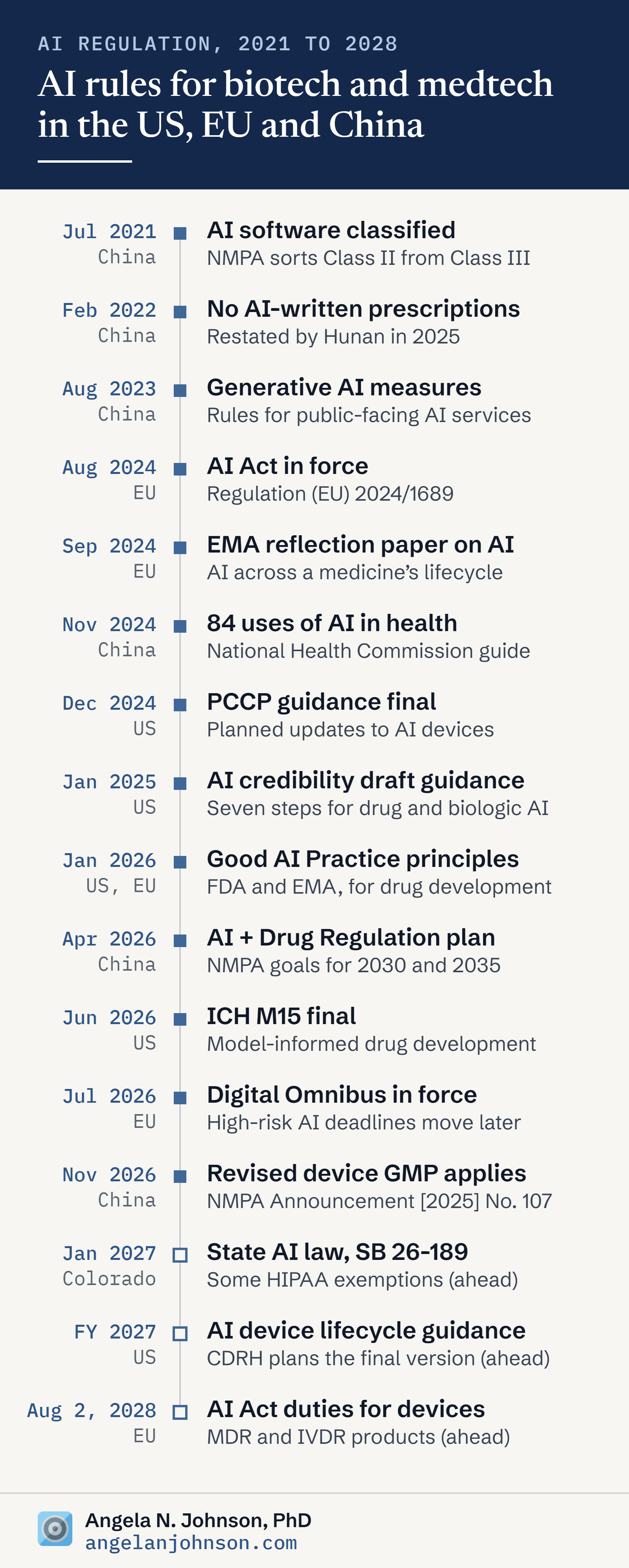
AI rules for biotech and medtech in the US, EU and China, 2021 to 2028. Hollow markers are dates still ahead. The source for each date is listed under Sources below.
Making the Right Strategic Bets on AI in Biotech and Medtech Development
For those doing diligence or planning strategic development programs, as well as the ecosystem of advisors and industry stakeholders supporting them and their academic and basic research collaborators, now is the time to look at your AI strategy. As you plan your development and investments for 2026, are you considering:
- Drug & Biotech AI Scale Up: Anchor models and context of use (CoU), where context remains king and regulatory and scientific AI are anchored in relevant data sources, or context. Using appropriate context, we can dramatically accelerate eCTD filings. Weave, an AI-enabled company that supports regulatory authoring, claims it can reduce about 100 hours of IND nonclinical written summaries to as little as 2.6 hours, and prepare a Module 3 first draft from source in minutes. We should also consider FDA’s 7-step credibility framework, EMA’s lifecycle reflection paper, and the joint 2026 FDA-EMA Guiding Principles. With FDA CDER planning 2026 guidance on AI/ML in pharmaceutical manufacturing and Computer Software Assurance (CSA), treat continuous process verification models and automated release tools under formal GMP validation—the way you can go wrong is lumping this under IT governance, it’s not strictly an IT issue. We need to upskill our GMP and QARA experts for the change. Formalize auditability and keeping human sign-off meaningful, not just a check-box activity as process automation with AI becomes more common.
- Software as a Medical Device (SaMD) Medtech focuses on AI that touches devices: For devices that include AI, plan change control early, using programs such as FDA’s Predetermined Change Control Plans (PCCPs) for US 510(k), De Novo, or PMA submissions, allowing your algorithm to be changed on the market—tech is moving fast, don’t let this opportunity get away. In EU, while high risk obligations for MDR/IVDR medical devices were recently deferred to August 2028 under the EU Digital Omnibus, plan for that deadline. In China, NMPA Class II and Class III filings will need to focus on verifying compliance with the new Medical Device GMP (November 2026), and from then on clinical evaluation reports (CERs) will need to meet the requirements of NMPA’s September 2026 draft guidelines. If your device incorporates LLM-based interfaces directly, that also means upskilling your team and staying on top of modern mechanistic interpretability, guardrails and safety, and usability standards that are evolving rapidly internationally.
- Clinical Workflow & Healthcare Delivery Tools (CDS, Triage & Admin AI): We’ve almost all seen physicians now taking notes with AI, and AI is beginning to touch patients and their health records. It is important to clearly define which tools are regulated SaMD (“medical devices”) and which are non-device Clinical Decision Support (CDS), and what falls in the gray area among international regulators. Some of the most challenging cases in development are where regulators disagree on this classification. As we implement AI enabled clinical and healthcare tools, it is critical that we enforce transparency and smart contracts with third party software providers (and yes, that means insisting on knowing what models they use, where the API endpoints are, and what obligations they have to inform you of changes when cloud models are used). We also need to do diligence and cross-functionally map IT security and clinical usability to ensure protected health information from public foundation model training pipelines remains private and compliant. We also need to watch evolving national and state regulations closely—it is a time of change—and ensure we comply with cross-border data transfers as per HIPAA, GDPR/EHDS secondary-use rules, and China’s cross-border data security assessments.
As we move forward, a new skillset that bridged medtech and biopharma are needed to ensure diligence, IT and GxP operations, and medicinal product development results with AI-enabled technology. This is precisely the intersection that is most exciting for me and professionals that have touched these fields.