
So Everyone’s Talking About AI in Cybersecurity, What Do I Actually Need to Know?
This year it seems like everyone and their boss (often the nontechnical ones too) are talking about cybersecurity and artificial intelligence.
- Published
- Reading time 4 minutes
- Topics Cybersecurity, AI leadership
This year it seems like everyone and their boss (often the nontechnical ones too) are talking about cybersecurity and artificial intelligence (AI), recoined as Super Intelligence (SI) in the United States under the President’s “Inaugurating the Era of Super Intelligence” Executive Order 14434 signed in September 2026. The cybersecurity landscape has changed too, with a shift in technical design to forefront observability, strict operational enforcement, and tightened mandatory breach-reporting windows. Broadly speaking, new United States (US) initiatives are focused on mitigating critical supply chain risks and we see the European regulatory authorities addressing both supply chain and rigorous privacy protections. And that has everyone talking about cybersecurity.
What has Changed in Cybersecurity: The Top 3 Areas to Look
Whether you are a product owner or security professional, one of the biggest themes is to keep an eye on the clock. That means what is reported, how fast, and our responsibilities to conduct investigations that meet public scrutiny are all under more time pressure. The enforcement behind these has grown real teeth in key regions, and governance and technical controls evolution are showing this. From manufacturers to clinical settings, IT security teams are focusing in on resilience, identity hardening, and containing risk associated with both health data and the flood of new interoperable and connected medical devices in an increasingly digital landscape.
Number One: Watching the Reporting Clock & Requirements State-by-State. The days of paper reporting are long over, and regulatory authorities expect real-time or near-real-time reporting in many cases. In the EU this is hitting hard, where the EU Cyber Resilience Act demands that applicable organizations submit early warning in less than 24 hours and fuller notifications in less than 72 hours. That means that Friday’s incident is on a regulator’s desk by Monday morning. While national level US rules (i.e. CISA’s 72-hour CIRCIA mandate, whose final rule is not yet in force) keep the 72-hour clock, individual states are also making tighter rulings with California, Vermont, Oklahoma, and Delaware all adding additional state-level requirements in 2026. In terms of privacy regulation, we are seeing more rigorous laws and regulations to come into effect in Kentucky, Rhode Island, and Indiana in January 2026, meaning more than twenty states are individually adding and enforcing additional consumer privacy statutes. Looking across the US, we can see it is pivoting hard into state-level enforcement, and the 2026 U.S. National Cyber Strategy reported the need to reduce compliance burdens on domestic businesses while also balancing the need for foreign-facing cyber operations and supply chain restrictions.
Number Two: Emergent AI-driven cybersecurity threats. It is also notable that White & Case’s 2026 outlook focused in on the need for training and technology strategies to address emergent cyber threats from artificial intelligence-driven, in particular those ransomware and supply chain vulnerabilities necessitate heightened vigilance. We are seeing more laws and working groups at standards committees coming together to address AI-enabled cyber threats, many of which pose real privacy and infrastructure risks. In March of 2026, major medical device company Stryker made headlines (right before the April 2026 initial Anthropic Mythos release announcement, adding interesting overall AI cyber context) when a hacktivist group exploited compromised privileged identity accounts in Microsoft Entra ID and Microsoft Intune admin tools, resulting in unexpected factory resets and wipes of thousands of corporate laptops, virtual servers, and BYOD devices inside Stryker’s own corporate environment, affecting real customers—though fortunately segmentation protected from patient facing safety events in Stryker’s products (i.e. Mako robots, LIFEPAK, and Vocera). While there is no public evidence AI was used, the industry speculated if agentic attacks could further exploit similar vulnerabilities. We’ve also seen a wave of breaches, including the prominent breach of Hugging Face by OpenAI’s own models in 2026, perhaps one of the most prominent examples of rogue agent behavior.
Number Three: Inadequate defense just got real teeth. Think about your defense strategy, is it moving at the pace of innovation? Are governance and the team doing the day-to-day security work prepared for the AI era in your organizations? The new baseline means preparedness not just response. NYDFS Part 500 enforced strict universal MFA rules with now per-day non-compliance penalties, and contractors in defense applications face a strengthened False Claims Act liability under the Cybersecurity Maturity Model Certification (CMMC) program for misrepresenting security maturity. Technical controls and accountability for defense is now an expectation, and one that is hitting small and midsized businesses hard, especially those serving into government and regulated industries. As we have been following the EU Cyber Resilience Act’s rollout, reporting in September 2026 became mandatory and we are on the cusp of the long anticipated December 2027 full rollout, which includes defensive measures and full product security for CE marked products.
What do I need to Do for Cybersecurity in 2027: Manufacturers, Hospitals, and Beyond
Based on your regional exposure and operations, now is the time to reassess security baselines, plan for AI-enabled sophisticated threats, and train staff. I always say put the focus on people. We can design technology solutions, but they are only effective when the risk owner and the individuals maintaining them understand how to implement, report, and effectively communicate defensive strategy. This means upskilling talent to embrace a new era of rapid investigation, heightened defensive posture, and evolving AI technologies.
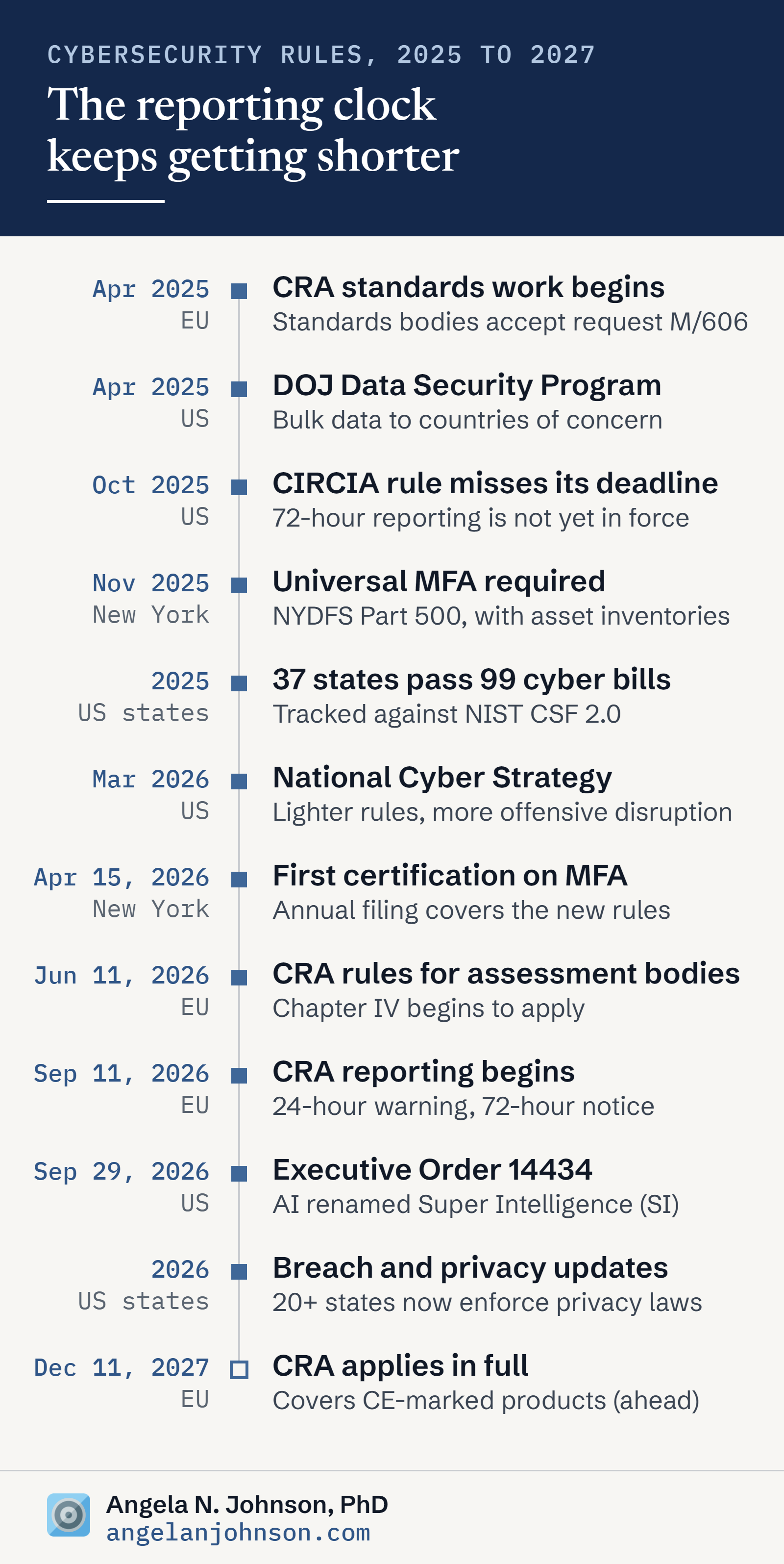
Cybersecurity rules, 2025 to 2027. Hollow markers are dates still ahead. The source for each date is listed under Sources below.