
Academics / Dissertation / Results
Metaphorsin innovation
How the people who develop and fund biomedical products talk about business, policy, and each other, and what their figures of speech carry with them.
- From My doctoral dissertation, results chapters
- Method Grounded theory, three sources coded together
- Quotations Checked word for word against the dissertation
Results
What I found
Metaphor was the most common device in the data
When I coded my interviews, metaphor turned up more than any other rhetorical device. I counted 177 metaphor codes across 16 of the 18 interview transcripts. Polarizing language came next with 85, and argument, narrative, and metonymy each had fewer than 30.
Following Lakoff and Johnson, I read this as a sign of how abstract the subject is. Policy, health, and innovation are hard ideas to explain plainly. Biomedical product development also sits where many social arenas meet, and its science is hard to carry from one discipline to the next. A metaphor gives everyone a shared picture to argue from.
I sorted what I heard by what was being described (business outcomes, policy, and communication itself) and by family. The same four families kept returning. Battle and sports language makes business a contest. Positional language puts success up high and progress ahead. Ecological and structural language treats a market as a living system or as something built from parts. Personifying language gives policy a face.
“As part of the present research, I propose that social world mapping and mapping of the rhetoric of metaphors used at the boundaries within biomedicine provide a fundamental basis for leaders to better gauge how their audience, and public, will respond to risk communications.”
Business talk runs on war and growth
To describe business outcomes, people reached for battle and sports words such as war chest, gauntlet, crush, and strangle, and for ecological ones such as grassroots, ecosystem, and explosive growth. One interviewee warned that not having your strategy and clinical trials worked out “can kill your business.” Positional metaphors put success above, at the next level or moving up.
Growth is the usual alternative. In my data it was often cut short by win or lose and live or die language, which technical communication scholars have tied to hegemonic masculinity. I argued that replacing battle and sports metaphors with ecological metaphors of growth may, in many cases, help build a collaborative culture.
Policy gets a personality
Policy drew the largest group of metaphors in my interview codes, spread roughly equally across the four families. People often personified it. As a threat, policy became mosquito bites, the boogeyman, or the big bad wolf lying in wait for an unsuspecting company. On the positive side, engaging with policy was likened to contributing to “your baby.” I read that image as told from a masculine perspective, with industry contributing to a baby born of public health agencies and the corporation cast as male.
American interviewees also called some other countries the Wild West, meaning places with lighter regulation and less mature policy. The phrase shows how North American professionals picture the wider professional world. I suggested that a careful communicator might trade it for metaphors of nurturing or growth.
“In the context of TCR practice and equitable social representation, a cognizant communicator might suggest replacement of the “Wild West” metaphor (one distinctly rooted in hegemonic white, masculine, American culture) with metaphors of nurturing or growth.”
TCR is technical communication and rhetoric, the field of the dissertation.
Inside the firm and across its walls
Talk about communication itself split along organizational lines. Ecological metaphors such as climate, ecosystem, and growth appeared both inside organizations and between them. Battle and sports metaphors did not appear in talk between organizations in different arenas, such as a company and its regulator or investors, except from one corporation to another. Inside a firm, sports language was about pace, pumping the brakes or getting up to speed, and not about combat.
Personifying metaphors were far more common inside organizations than between them, and there communication became forgiving, sharing, or embracing. Positional metaphors for communication were about coming together rather than moving up, in the same boat and on the same page. Communication itself became a conduit or a chain link, with bottlenecks.
Metonymy did quieter work. A “white coat” or a “prescription pad” stood in for a doctor, and “big pharma” for large corporations. Calling a doctor a white coat groups the doctor with the technology and the hospital, and apart from people such as patients and family members.
The categories
Four families, and one stand-in
The examples are the words in my data, as I coded them.
-
Battle, war, and sports
Business and policy as a contest to be fought, won, or survived.
- War Chest
- Gauntlet
- Crush
- Hurdles
-
Positional and orientational
Success as height, and progress as a direction or a path to find.
- Moving up
- next level
- Bootstraps/Bootstrapping
- Navigating
-
Ecological and structural
Markets and firms as living systems that grow and mature, or as structures built from parts.
- Grassroots
- Ecosystem
- Explosive Growth
- Red Tape
-
Personifying and symbolic
Policy and communication given a face, a temper, or a place in the family.
- Big Bad Wolf
- Boogeyman
- Mosquito Bites
- Your Baby
-
Metonymy
An object or a label standing in for a whole group of people.
- white coat
- prescription pad
- big pharma
- small guy
From the dissertation
Innovation, and what it is set against
My map of the polarizing rhetoric people used about biomedical innovation, in the interviews and the survey.
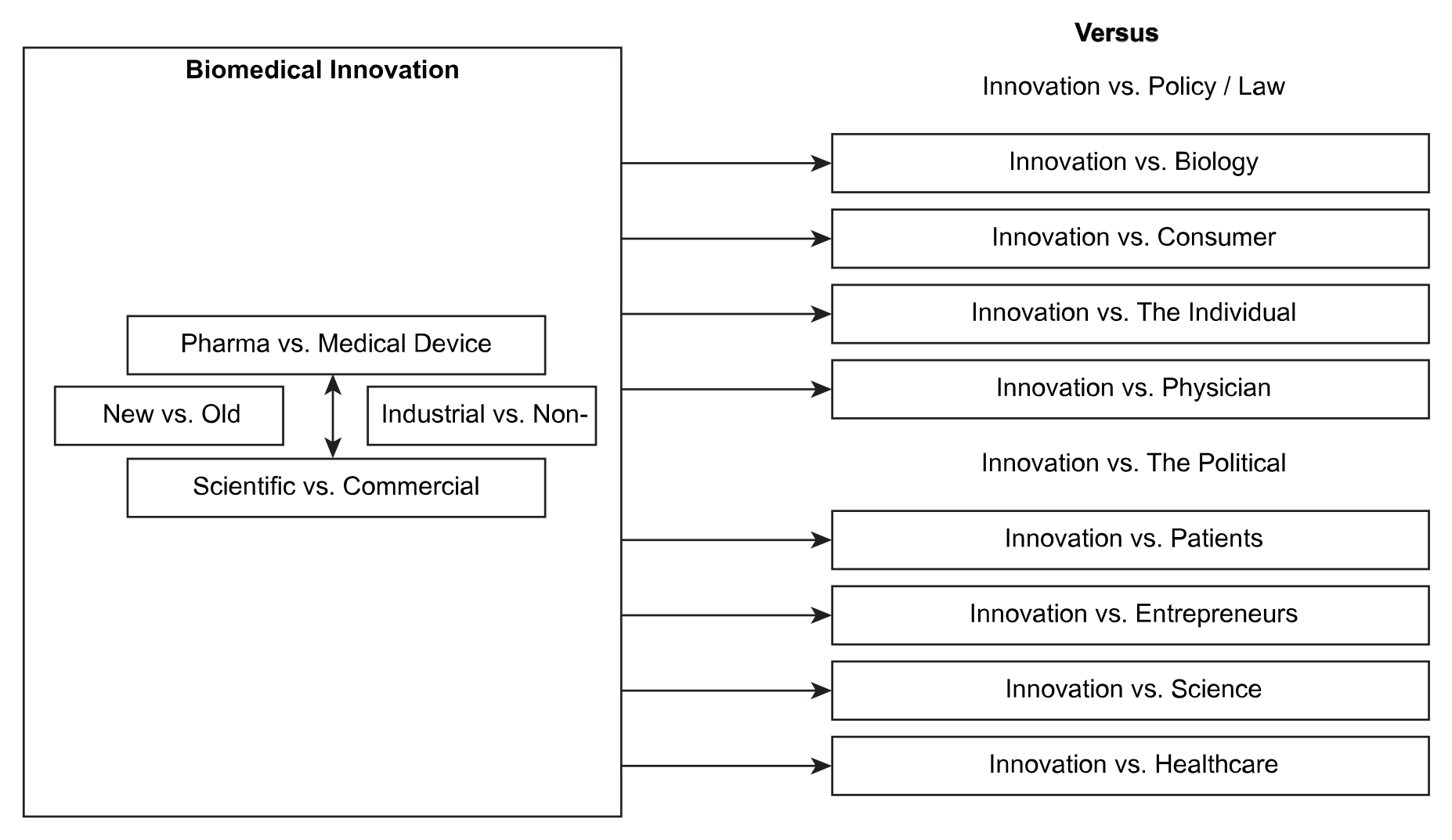
My tables, in full
Every metaphor, as I coded it
Three tables from chapter 5, cell for cell, read out of the dissertation. The phrases are the words in my data, sorted into families.
Table 5.9 · Dissertation, p. 229
Observed Business Outcome Metaphors in Biomedical Innovation Policy Research
| Battle/War (or Sports) | Positional/Orientational | Ecological |
|---|---|---|
| Bang for The Buck, Gauntlet, Breaking In, Hitch, Kill, Hold Off, Behemoth, Win, Rewards, Bounty, Snatch, Squash, Crush, Strangle, Test, War Chest, Win/Lose, Worth the Shot | Big Picture, Pulling up by the Bootstraps/Bootstrapping, Levels, Leap, Moving up, On Top, Upward Bound | Grassroots, Growing, Phenotype, Trickle, Flow, Climate, Ecosystem, Environment, Evolve, Explosive Growth, In the Weeds, Landscape, Machine, Mechanism, Maturing, Organisms, Snowballing, A Baby |
Table 5.10 · Dissertation, p. 230
Observed Policy Representation Metaphors in Biomedical Innovation Policy Research
| Battle/War (or Sports) | Positional/Orientational | Ecological/Structural | Personifying/Symbolic |
|---|---|---|---|
| Bites, Blocks, Burden to Bear, Celebrity of the Day, Cover Rear Ends, Entangled, Force, Game the System, Getting Away With, Hoops, Hurdles, Pendulum, Hits, Roll Out, Slap, Slapped on Wrist, Streamlining, Surfing and Wiping Out, Survival, Winners and Losers | Balance, Behind the Scenes, Bend the Rules, Big Picture, Bigness, Dark Ages, Direction, Driving, Fit, Fit Mold, Going Far, Lag Behind, Layers, In Line, Lost In, Map, Middle of Road, Moving Pieces, Navigating, Nebulous On Top, Path, Pushing, Puzzle, Ratcheted Up, Tighten Down, Wild West, Forward, Hop On, On Top Of | Bad Apple, Bricks/Blocks, Cornerstone, Even Playing Field, Fever, Get a Handle, Gray Area, Hives, Horizon, Lead Balloon, Recreate the Wheel, Red Tape, Ripple Effect, Stay Abreast, Stepping, Stick, Stifled, Storms, Swamp, Trickle Down, Waves, Width, Window Dressing Better Mouse Trap, Magnification, Pipeline, Road Bend, Water Level | Big Bad Wolf, Boogeyman, Dark Ages, Friendly, Goodness, Gospel, Happy, Head Scratching, Brain, Mosquito Bites, Speaking Different Languages, Speed Limit, Translation, Your Baby |
Table 5.11 · Dissertation, p. 232
Observed Organizational Communication Metaphors in Biomedical Innovation Policy Research
| Battle/War (or Sports) | Positional/Orientational | Ecological/Structural | Personifying/Symbolic | |
|---|---|---|---|---|
| Between Organizations | n/a | Meet in Middle, Separate, Taking | Chain Links, In the Weeds, Formulating | n/a |
| Both | Hurdles | n/a | Carving a Niche, Climate, Landscape, Ecosystem, Environment, Evolve, Growth, Landscape, Machine, Mechanism, Networks, Maturing, Organisms, Snowballing | n/a |
| Within Organizations | Crunch, Drill Down, Force, Pump Brakes, Springboard, Tailspin, Tied In, Up to Speed | Close to Home, In House, In Your Shoes, Jump Onboard, Leap of Faith, Misalignment, Same Boat, Same Page, Seat at the Table | Absorbing Information, Bottlenecks, Burned, Chained, Crap, Colored, Conduit, Ebb and Flow, Filter, Growth, Guinea Pig, Illuminate, On the Ground, Open Air, Pipeline, Rock and Hard Place, Turn Over Stone | ABCs, Air Quotes, Big Bad Wolf, Biggest Person, Blind, Embracing, Feeling, Forgiveness Not Permission, Got the Memo, Grab Headlines, Joining Hands, Lean on People, Many Hats, Meeting of Minds, Pioneer, Wealth of Information, Weaving Together, Wide Eyed, Bushy Tailed, Science Did It |
In the dissertation’s words
Findings, quoted
-
“In the process of emergent coding using Grounded Theory methods, it becomes apparent that one of the most frequently observed categories in textual and visual data is the metaphorical construct.”
p. 174
-
“Among these, the ecological metaphor of growth is commonly used in business, but is often oddly truncated with win/loss or live/die rhetoric, which calls back to hegemonic masculinity.”
p. 228
-
“Of particular interest, a policy is often personified in both a negative and positive light.”
p. 229
-
“Moreover, except corporation-to-corporation communication, communications between organizations in separate social arenas (e.g., corporations to healthcare/regulators/investors/etc.) did not use sports or battle metaphors, common in corporate organizations’ discourses on business outcomes.”
p. 230
Why it matters now
For the people who build and fund
Metaphors carry complex ideas across the boundaries between science, business, regulation, and care, and they carry their culture with them. I proposed that mapping the metaphors used at those boundaries gives leaders a better basis for judging how an audience will hear a message about risk. I also argued that leaders can choose their metaphors consciously, and that trading battle talk for growth talk may make a culture more collaborative.
In the dissertation
More figures and tables
The table behind these counts is in the full text, on the page below.
- Table 4.5 Focused Coding of Interview Data (N = 18) Page 137
Full text at Texas Tech What pictures really mean in biomedicine Back to teaching and philosophy