
Academics / Doctoral dissertation
Policy Knowledge in Innovation Ecosystems of Global Biomedical Ventures
Entrepreneurial communication in decision-making, risk-taking, and competitive advantage.
- Degree PhD, Technical Communication and Rhetoric, Texas Tech University
- Committee Rich Rice (chair), Scott Weedon, Steve Holmes, Kirk St.Amant
- Design Multi-method. A survey, interviews, and web artifacts
- Entry point The 21st Century Cures Act
In brief
How ventures learn the rules of the future
A new medical technology reaches patients only after its makers persuade investors, regulators, and clinicians to believe in a future that does not exist yet. I wanted to know how the people who run biomedical ventures learn the policy that governs that future, and what they do with it.
I took the 21st Century Cures Act as the entry point. I surveyed and interviewed business leaders, investors, and scientific professionals, collected the public web pages of the organizations they named, and coded all of it together with grounded theory methods.
The result is a map of the social worlds of biomedical innovation, and an account of how differently large and small firms come to know the same policy.
“Innovation institutions thrive by engaging our imagination to visualize what their technology can do in the future, and are thus reliant on rhetoric that establishes expectations for the future state.”
- 82 Completed surveys
- 18 Unstructured interviews
- 22 Web artifacts
- 1,040 Code groups
Counts as reported in the abstract. The statistics are exploratory, and the study was built for depth.
Research questions
What the study set out to ask
- Question 1 “What human and nonhuman social worlds, arena, and actor/elements affect the organizational innovation situation in the biomedical product development process?” Dissertation, p. 258
- Question 2 “How do small and larger entrepreneurial corporate ventures build knowledge capital by leveraging biomedical policy diffusion?” Dissertation, p. 258
- Question 3 “How is innovation policy knowledge disseminated across human and nonhuman elements within the social situation of biomedicine, including by key human collective groups (investment/finance professionals, medical executives, and research workers)? Does this alter innovation outcomes related to decision-making, risk-taking, and competitive advantage in biomedical ventures?” Dissertation, p. 258
The map
Seven arenas around one technology
The answer to the first question is a drawing. It shows who has to be persuaded before a product exists.
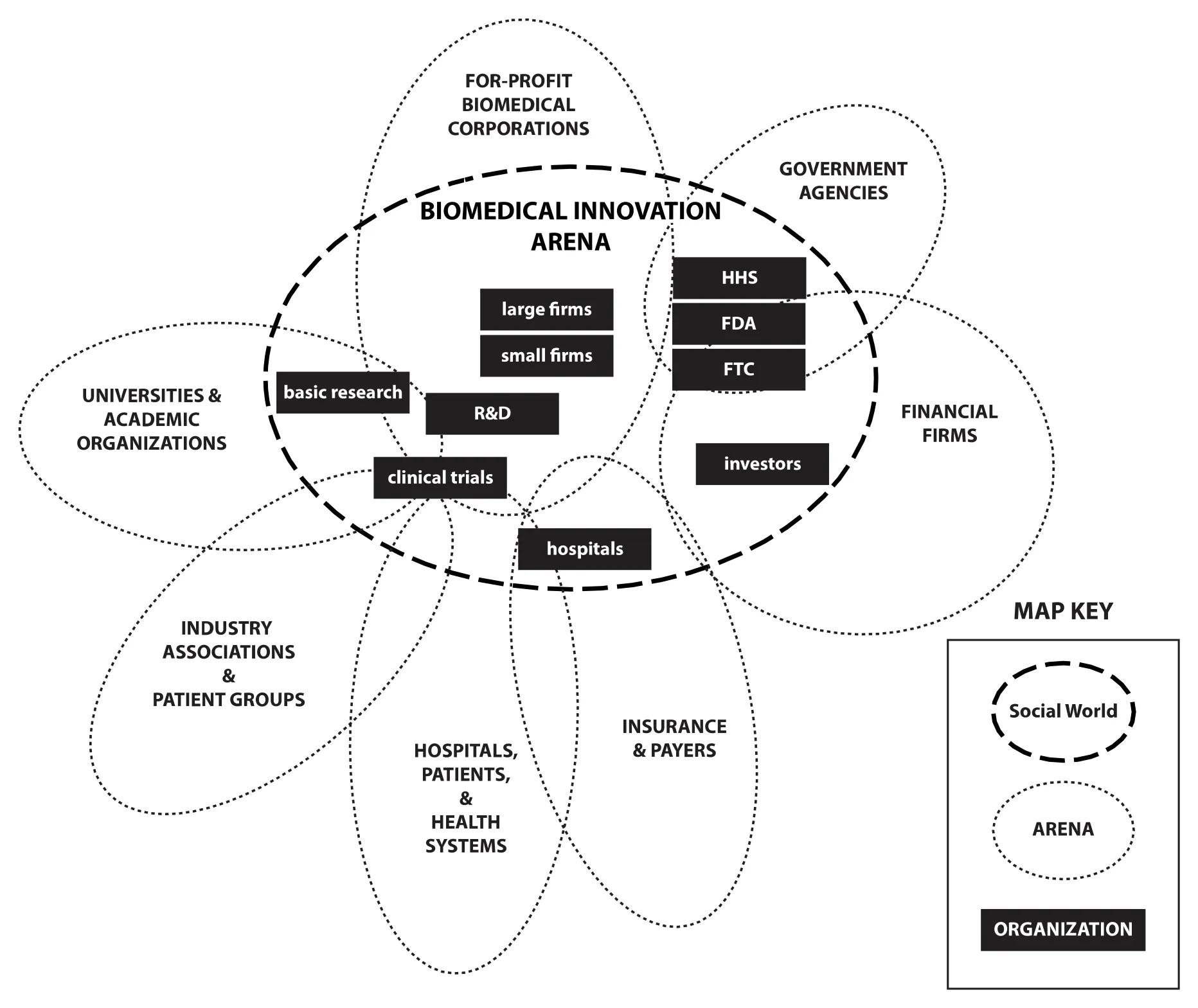
The seven social arenas
- The biomedical product industry
- Government agencies and the judiciary
- Financial and investment firms
- Insurance and payers
- Hospitals and health systems
- Patient associations
- Universities and academic centers
Findings
What the study concluded
In the dissertation’s own words, with the page each passage is on.
-
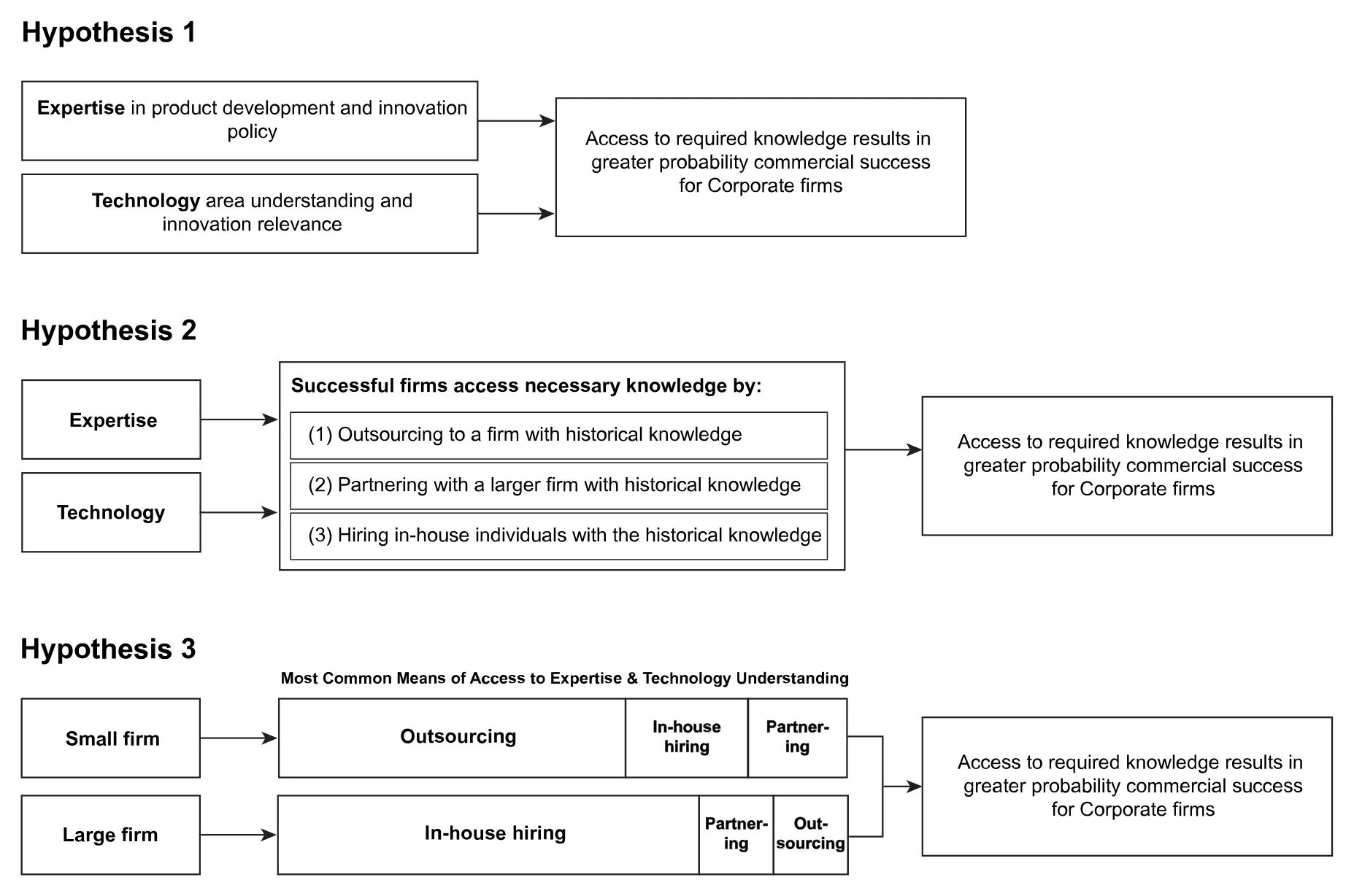
Large and small firms know policy differently
“Results show that knowledge dissemination related to innovation policy is distinctly polarized between large and small business ventures”
“Start-ups and small firms face additional barriers to knowledge transfer of innovation policy, particularly in dynamic policy environments; to remain competitive they rely more heavily on partnering and outsourcing to bring the required knowledge capital into their organizations.”
-
Leaders hold two futures at once
Of the leaders of small biotechnology firms.
“CEOs and leaders within these firms tend to engage in performative rhetoric based on these public and socially connected expectations, while retaining private argument on both pessimistic and optimistic futures.”
-
Policy is understood through metaphor
“Policy and innovation are complex topics, which are most often understood and communicated through the use of metaphors, including ecological, pathfinding, and personifying metaphors used to describe complex systemic relationships in ways relatable to individuals. These metaphors may also be represented visually.”
-
Legitimacy is made in communication
“Even technically excellent firms that fail to engage in these social communication processes can lack the credibility, or legitimacy, to achieve funding and advance their technology forward.”
-
Communication is a business outcome
“Communication outcomes are closely linked to business outcomes, like the decision to invest, regulatory review/approvals, and business decision-making; understanding such communications can prepare practitioners to better engage in strategic decision-making of industry.”
-
Rhetoric hides the barriers
“By examining polarizing rhetoric and metaphorical constructs in the discourses of biomedical professionals, it is possible to elucidate and address underlying hegemonies, which pose silent barriers that slow collaboration, knowledge building, and, ultimately, innovation development.”
For teaching
A way in for students
The map was also made to be taught from.
“The visualizations resulting from this study are also intended as a teaching resource, to enable scholars, students, and future practitioners a more accessible entry point into the complex landscape of biomedical product development.”
The lesson for the classroom is that “while some technical knowledge is needed for the study of innovation, the study of the social contexts of persuasive rhetoric is accessible and should not be intimidating as subjects in the TCR classroom and scholarly research.”
Foundations
The traditions it works in
- Entrepreneurial and technical communication, after Spinuzzi and Doheny-Farina
- Constructivist grounded theory, after Charmaz, and Glaser and Strauss
- Situational analysis and social worlds, after Clarke, Strauss, and Star
- Multi-method research, after Brewer and Hunter
- Actor-network theory, after Latour and Callon, which it uses and argues with
- Biopolitics, after Foucault
- Conceptual metaphor, after Lakoff and Johnson
- The sociology of expectations, after Borup, Brown and Michael, and Tutton
Contents
Six chapters, in plain words
- Chapter 1 Why policy knowledge is a communication problem Entrepreneurism, innovation policy, and the Cures Act as subjects for technical communication.
- Chapter 2 The literature and the method Knowledge in ventures, decision-making, risk-taking, competitive advantage, grounded theory, and multi-method research.
- Chapter 3 Methodologies Recruitment, interviews, the online survey, web artifacts, coding, and research compliance.
- Chapter 4 Results The survey, the interviews, and the web artifacts, including the visual rhetoric of innovation imagery.
- Chapter 5 Synthesis The social world map, its arenas, large and small firms, metaphors, and how policy knowledge travels.
- Chapter 6 Conclusions What it means for leaders of ventures, for teaching, and for future study.
Read and cite
The full text is at Texas Tech
“In a society where financial incentives drive new product development, how can we ensure that the biomedical products most needed by the public are, indeed, profitable to develop?”
Johnson, A. N. Policy Knowledge in Innovation Ecosystems of Global Biomedical Ventures: Entrepreneurial Communication in Decision-making, Risk-taking, and Competitive Advantage [Doctoral dissertation, Texas Tech University]. Texas Tech University Libraries. ttu-ir.tdl.org/items/499172ab-ebcb-402f-8419-1f05ed2956b4
Get in touch
Speaking, teaching, board work, or coaching
I am glad to hear from conference organizers, journalists, students, and leaders who want a thinking partner.